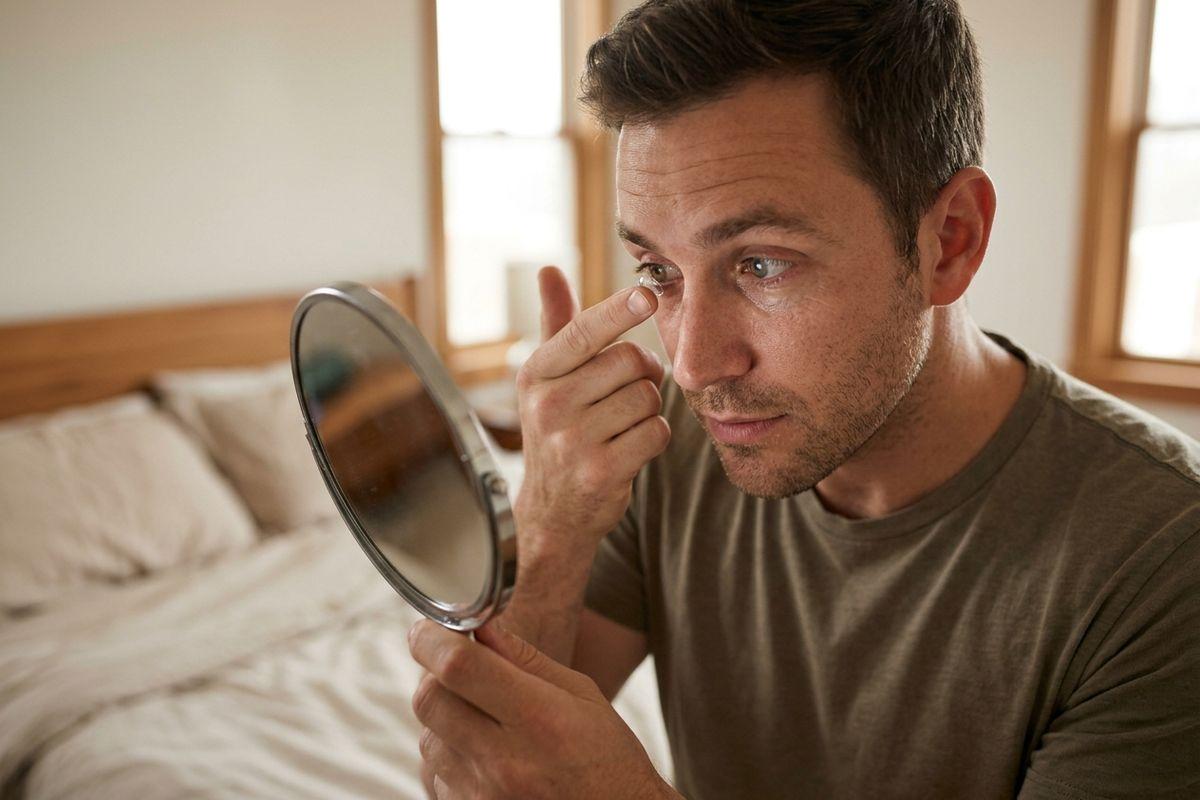
Adult inserting a contact lens while holding a handheld mirror, sitting beside a bed near a window.
Most people correct nearsightedness with glasses or daytime contacts. Orthokeratology, or ortho-k, works differently. You wear special lenses while you sleep, take them out in the morning, and go about your day without glasses.
Parents often ask about it when they’re looking into myopia control for their kids. It also comes up with adults who’ve struggled with daytime contact lenses and want another option. Ortho-k can be a good fit if you’re nearsighted and you’re willing to wear and clean your lenses every night. We’ll still need to look at your prescription and the shape of your eyes before we can say for sure.
How Ortho-K Works
Orthokeratology uses custom, rigid gas permeable lenses that gently and temporarily reshape the front surface of your eye while you sleep. This clear front surface is called the cornea. Put the lenses in at bedtime and take them out when you wake up.
Your cornea can hold its new shape through the day, so you may see clearly without glasses or contacts. Ortho-k is mainly used for myopia, the technical term for nearsightedness. If you have myopia, things up close look clear while objects in the distance look blurry.
How Ortho-K Lenses Compare to Daytime Contacts
Ortho-k lenses are firmer and smaller than the soft contacts most people picture. You wear them at night, so you can stay free of glasses and contacts during work, school, or the gym.
You’ll still need to clean them every day. It’s also smart to keep a pair of backup glasses at home for any night you can’t wear your lenses.
Who Ortho-K May Suit
Some people are drawn to ortho-k for comfort, others for convenience. The groups who ask about it often include:
- Kids and teens whose prescriptions keep changing
- Adults who play sports or work outdoors in dusty conditions
- People who find daytime contacts dry or uncomfortable
Ortho-K for Myopia Control in Kids
Nearsightedness often gets worse as children grow, and ortho-k is one of the options optometrists can use to slow that progression. Many studies have looked at kids around age 7. Even so, your child’s maturity matters more than their age, since they’ll need to follow a nightly routine with your help.
That routine can work in your family’s favour. Your child puts in and takes out their lenses at home with a parent nearby, and they won’t have to deal with contacts at school.
Prescriptions That Tend to Work Well
Ortho-k tends to suit lower to moderate myopia. It can also correct low levels of astigmatism, a common condition in which the cornea is oval rather than round.
What to Expect During the Fitting Process
Getting fitted for ortho-k usually takes a few visits:
- A comprehensive eye exam and a detailed map of your cornea taken with a corneal topographer
- A lens pickup appointment, where we’ll show you how to put in and take out your lenses
- Follow-up visits after your first night and your first week, then regular checkups after that
Some people notice clearer vision within a few days. It often takes 1 to 2 weeks to reach the full effect, and your vision may change a little between morning and evening while your eyes adjust.

Person in blue T-shirt and shorts standing on a rocky dirt trail, looking out over dry sagebrush hills and a wide valley.
The Drawbacks of Ortho-K
Ortho-k asks for an ongoing commitment. If you stop wearing your lenses each night, your corneas will gradually return to their original shape and your nearsightedness will come back.
The upfront cost can also run higher than a supply of soft lenses. And you may notice the lenses a bit during your first few nights.
Lens Care and Infection Risk
Wearing any contact lens overnight raises your risk of a serious eye infection, so daily care matters. Build these habits into your routine:
- Wash and dry your hands before you touch your lenses
- Clean and disinfect your lenses every day with the solution we give you
- Keep tap water away from your lenses and your case
- Attend every follow-up appointment
How to Decide if Ortho-K Fits Your Life
Bring your questions to your appointment. Ask what the fitting includes and how often you’ll need to replace the lenses. It’s also worth checking what your extended health plan may cover. Then compare the cost over 2 or 3 years with what you’d spend on disposable contacts and solution.
If ortho-k isn’t a match for your eyes, we can talk through other options, such as myopia control glasses or atropine eye drops for kids, and daily soft or specialty contact lenses for adults.
Find Out if Ortho-K Suits Your Eyes
Ortho-k becomes part of your nightly routine for as long as you wear it, so it helps to have a clear picture before you start. Our team at Summit Eyecare Centre can map your corneas and give you an honest answer about whether ortho-k suits you. We’ll also walk you through the costs before you commit.
Book an appointment online or give us a call. Bring your insurance details, and we can handle the billing for you.